
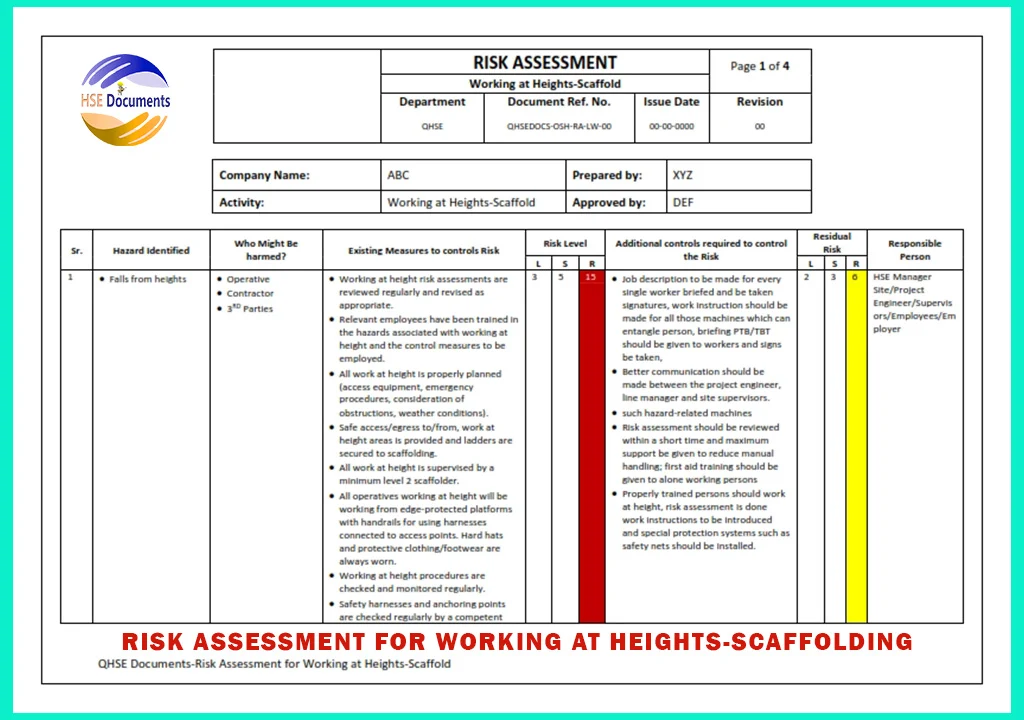
Working at height remains the biggest single cause of fatal and serious injuries across many industries, particularly in construction work. Every year, over 60% of deaths during elevated work involve falls from ladders, scaffolds, platforms, and roof edges. These accidents are largely preventable through proper risk assessment and planning.
Employers must assess the risks, identify necessary precautions, and record their findings before any work at height begins. The law requires this systematic approach to protect workers and prevent tragic incidents. A comprehensive risk assessment helps identify potential hazards, evaluate the likelihood of accidents, and implement appropriate control measures.
Understanding how to conduct an effective working at height risk assessment can save lives and ensure legal compliance. The process involves following a clear hierarchy of controls, from avoiding height work entirely to implementing fall protection systems. Proper assessment also includes selecting appropriate equipment, training workers, and maintaining clear documentation throughout the project.
Key Takeaways
- Risk assessment must follow a systematic hierarchy that prioritises avoiding height work before considering fall protection measures
- Employers are legally required to assess risks, implement control measures, and provide proper training before work begins
- Regular documentation and review of safety procedures ensures ongoing protection and compliance with safety regulations
What Is Working at Height Risk Assessment?
A working at height risk assessment is a mandatory evaluation process that identifies potential hazards and controls risks when employees work above ground level. This systematic approach ensures legal compliance whilst protecting workers from falls and serious injuries.
Definition and Scope
Working at height risk assessment is a formal process where employers evaluate dangers associated with any work activity where a person could fall and sustain injury. This includes work on ladders, scaffolding, roofs, or any elevated surface.
The assessment covers all workplace situations where falling hazards exist. It applies to permanent and temporary work positions above ground level.
The scope extends beyond obvious high-level work. It includes working near excavations, fragile surfaces, or anywhere a fall could cause harm. The assessment must consider equipment, environmental conditions, and worker competency.
Key areas covered include:
- Identifying fall hazards
- Evaluating risk levels
- Determining control measures
- Planning safe work methods
- Training requirements
Why It Is Essential for Safety
Falls from height remain the leading cause of workplace fatalities in construction and other industries. Over 60% of work at height deaths involve falls from ladders, scaffolds, and roof edges.
Risk assessments prevent accidents by identifying hazards before work begins. They establish proper safety measures and ensure workers understand the risks they face.
The assessment process protects both individual workers and entire teams. It creates structured approaches to hazardous tasks rather than relying on chance or experience alone.
Safety benefits include:
- Reduced accident rates
- Lower insurance costs
- Improved worker confidence
- Better safety culture
- Enhanced productivity
Key Legal Requirements
The Work at Height Regulations 2005 make risk assessments legally mandatory for all work at height activities. Employers must assess risks and implement appropriate control measures before work commences.
Legal duties require employers to avoid work at height where possible. When unavoidable, they must prevent falls or minimise injury consequences through proper planning and equipment.
The regulations demand that assessments identify significant findings and review them regularly. Method statements must communicate safety requirements to all involved workers.
Legal obligations include:
- Conducting thorough risk assessments
- Following hierarchy of control measures
- Providing adequate training
- Ensuring proper supervision
- Maintaining equipment standards
- Recording significant findings
Compliance failures can result in prosecution, fines, and serious legal consequences for employers and contractors.
Major Hazards Associated with Working at Height
Falls from height cause over 60% of workplace deaths in high-risk industries. Workers face danger from unstable ladders, scaffolding failures, and fragile roof surfaces that can collapse without warning.
Falls from Height
Falls from height represent the most significant risk in elevated work environments. Workers commonly fall from ladders, scaffolding, working platforms, and roof edges.
Ladder-related incidents occur when equipment is incorrectly positioned, damaged, or used beyond its safe working load. Poor maintenance leads to structural failures during use.
Scaffolding hazards include inadequate guardrails, missing toe boards, and unstable foundations. Workers often fall when platforms are not properly secured or when accessing scaffold structures.
Platform failures happen when temporary working surfaces cannot support the combined weight of workers, tools, and materials. Edge protection failures also contribute to serious accidents.
Workers frequently fall when moving between different levels without proper access routes. Lack of training increases the likelihood of unsafe practices that result in falls.
Falling Objects
Falling objects pose serious risks to workers both at height and ground level. Tools, materials, and debris can cause severe injuries or fatalities when dropped from elevated positions.
Tool drops occur when workers fail to secure equipment properly. Hand tools, power tools, and small components can become dangerous projectiles.
Material hazards include construction materials, fasteners, and waste that fall during lifting operations or due to inadequate storage on platforms.
Structural debris presents risks when demolition work or maintenance activities dislodge building components. Wind can also move unsecured materials.
Proper tool tethering and exclusion zones help prevent falling object injuries. All personnel below work areas require appropriate head protection.
Fragile Roofs and Surfaces
Fragile roofs and surfaces can collapse suddenly under a person's weight. These materials often appear solid but cannot support normal working loads.
Roof lights and skylights frequently break when stepped on, causing workers to fall through openings. Older installations are particularly vulnerable to failure.
Deteriorated roofing materials include asbestos cement sheets, metal panels, and plastic coverings that have weakened over time. Weather exposure reduces structural integrity.
Concealed fragility makes identification difficult, as some surfaces appear safe but have internal damage or inadequate support structures beneath.
Workers must never walk directly on suspected fragile surfaces. Proper access platforms and fall protection systems are essential for safe roof work.
Steps to Conduct a Comprehensive Risk Assessment
A systematic approach to working at height risk assessment involves three critical phases that build upon each other. Proper hazard identification forms the foundation, followed by determining exposure levels and implementing appropriate safety measures.
Identifying Hazards
The first step requires a thorough examination of all potential dangers associated with the specific work at height task. Assessors must consider both obvious and hidden hazards that could cause harm.
Physical hazards include unstable surfaces, weather conditions, and electrical equipment. Fragile roofs, wet surfaces, and strong winds pose significant risks that must be documented.
Equipment-related hazards cover faulty ladders, damaged scaffolding, and inadequate fall protection systems. Each piece of equipment requires inspection before use.
Environmental factors such as poor lighting, noise levels, and proximity to traffic or machinery create additional risks. These conditions can impair worker judgment and increase accident likelihood.
A comprehensive hazard identification process examines each work phase separately. Setup, access, task execution, and descent all present different risk profiles that require individual assessment.
Determining Who May Be at Risk
This phase identifies all individuals who could be affected by the work at height activities. The assessment must extend beyond direct workers to include everyone in the vicinity.
Primary workers performing the height-related tasks face the most direct exposure. Their experience levels, training status, and physical capabilities affect risk levels significantly.
Contractors and subcontractors working nearby may lack familiarity with site-specific hazards. Their risk assessment template should address coordination between different work teams.
Ground-based personnel risk injury from falling objects or equipment failures. Security staff, cleaners, and visitors require protection through exclusion zones or alternative routes.
Members of the public near construction sites or maintenance areas need consideration. Pedestrians and vehicle operators may encounter unexpected hazards from overhead work activities.
Documentation must record specific numbers of people at risk and their roles. This information helps determine appropriate control measures and emergency response requirements.
Evaluating Risks and Selecting Precautions
Risk evaluation combines hazard severity with likelihood of occurrence to prioritise control measures. This systematic approach ensures resources focus on the most significant dangers.
Risk rating systems typically use matrices that multiply severity by probability. High-risk activities require immediate attention, whilst lower risks may proceed with standard precautions.
Control hierarchy prioritises elimination and substitution over personal protective equipment. Can the work be done from ground level? Can safer access methods replace ladders?
Engineering controls such as guardrails, safety nets, and fall arrest systems provide reliable protection. These measures protect multiple workers simultaneously and don't rely on individual behaviour.
Administrative controls include training, permits to work, and supervision requirements. Weather monitoring and restricted access during adverse conditions form part of this category.
The working at height risk assessment must specify exact control measures for each identified hazard. Generic solutions rarely provide adequate protection for specific workplace situations.
Essential Risk Control Measures for Work at Height
Effective control measures follow a strict hierarchy that prioritises avoiding work at height entirely, then preventing falls through collective protection like guardrails, and finally using personal protective equipment as a last resort.
Hierarchy of Control
The hierarchy of control provides a systematic approach that must be followed in order. Employers cannot skip to lower levels without proving higher levels are not reasonably practicable.
Avoid work at height wherever possible. This includes assembling guardrails on steelwork at ground level before craning into position. Cast-in mesh can be installed across riser ducts during construction.
Prevent falls using existing safe places of work. Flat roofs with permanent edge protection eliminate the need for additional equipment.
Prevent falls with collective protection equipment. Independent scaffolds, tower scaffolds, and mobile elevating work platforms protect all workers simultaneously.
Mitigate fall consequences through nets positioned close to work surfaces. Personal fall arrest systems serve as the final option when prevention is impossible.
Collective Protection: Guardrails and Edge Protection
Guardrails and edge protection systems protect all workers in an area without requiring individual equipment. These systems take priority over personal protective equipment in the control hierarchy.
Standard guardrails must be 950mm high with intermediate rails and toe boards. Edge protection prevents tools and materials from falling whilst protecting workers from drops.
Scaffolding systems provide comprehensive collective protection. Tower scaffolds offer mobility for smaller jobs. Mobile elevating work platforms combine access and protection in one system.
Permanent edge protection on buildings eliminates ongoing risks. Temporary systems must be properly designed and installed by competent persons.
Personal Protective Equipment and Fall Arrest Systems
Personal protective equipment serves as the final control measure when collective protection is not reasonably practicable. Fall protection systems include harnesses, lanyards, and anchor points.
Work restraint systems use short lanyards that prevent workers reaching fall positions. These systems are preferable to fall arrest as they prevent falls entirely.
Fall arrest systems stop falls after they begin. Full body harnesses distribute forces safely across the body. Energy-absorbing lanyards reduce impact forces during arrest.
Anchor points must support 15kN minimum force per person attached. Regular inspection of harnesses and lanyards is essential. Only competent persons should select and use fall protection systems.
Equipment, Procedures, and Environmental Considerations
Proper equipment selection and safe procedures form the foundation of working at heights safety. Weather conditions and comprehensive training programmes directly impact worker safety and accident prevention rates.
Safe Use of Ladders and Scaffolding
Ladders may only be used for working at heights when risk assessment shows other equipment is not justified due to low risk and short duration. Work on ladders must not exceed 30 minutes at a time.
Workers must inspect ladders before each use. They should check for cracks, bent sections, or damaged rungs. The ladder must be placed on firm, level ground at the correct angle.
Scaffolding requires professional installation and regular inspection. Independent scaffolds and tower scaffolds must include guardrails and toe boards. Workers must never remove safety components during use.
Mobile elevating work platforms (MEWPs) offer safer alternatives to traditional scaffolding. These platforms provide collective protection through built-in guardrails. Operators need proper certification before using MEWPs.
All access equipment must undergo routine maintenance checks. Companies should keep detailed records of inspections and repairs. Damaged equipment must be removed from service immediately.
Establishing Safe Work Procedures
Method statements provide essential communication tools for height work. These documents identify specific hazards and required precautions for each task. Statements should include simple sketches when necessary.
Workers need clear instructions about equipment requirements before starting work. The method statement must specify what actions to take if work methods change. Supervisors should review procedures with teams during toolbox talks.
Safe work procedures follow the hierarchy of controls systematically. Companies must avoid working at heights when possible. When height work is necessary, collective protection takes priority over personal protective equipment.
Equipment needed for safe working must be available before work begins. Workers should understand their roles and responsibilities clearly. Emergency procedures require regular practice and review.
Weather Conditions and Work Planning
Wind conditions significantly affect working at heights safety. Work should stop when wind speeds exceed safe limits for specific equipment types. Rain creates slippery surfaces that increase fall risks substantially.
Temperature extremes affect worker performance and equipment reliability. Cold weather makes materials brittle and reduces grip strength. Hot conditions can cause heat stress and reduced concentration levels.
Visibility plays a crucial role in height work safety. Poor lighting conditions require additional illumination before work proceeds. Fog or heavy precipitation should delay non-essential height activities.
Project managers must monitor weather forecasts continuously. They should establish clear criteria for stopping work due to conditions. Alternative indoor tasks help maintain productivity during unsuitable weather periods.
Preventing Accidents through Training
Workers need comprehensive training before performing height work. Training programmes must cover equipment use, hazard recognition, and emergency procedures. Competent persons should deliver all safety instruction.
Toolbox talks reinforce key safety messages regularly. These brief sessions address specific risks for planned activities. Supervisors should encourage questions and open discussion during talks.
Training records demonstrate compliance with safety regulations. Companies must maintain certificates and refresh training periodically. New workers require thorough induction before accessing height work areas.
Regular safety meetings help identify emerging risks. Teams can share experiences and suggest improvements. Ongoing education keeps safety awareness levels high throughout projects.
Documentation, Training, and Reviewing Risk Assessments
Proper documentation creates a clear record of hazards and controls, whilst regular training ensures workers understand safety procedures. Risk assessments require ongoing review to maintain effectiveness and meet changing workplace conditions.
Recording and Communicating Findings
Employers must record significant findings from their risk assessments. The documentation should clearly identify hazards, control measures, and responsible persons for each safety procedure.
A risk assessment template helps standardise the recording process. The template should include sections for hazard identification, risk ratings, and control measures. This ensures consistent documentation across all work at height activities.
Method statements work alongside risk assessments to communicate safety requirements. These documents should be clear and include simple sketches when necessary. Workers need practical guidance they can follow on site.
Key information to record:
- Identified hazards and risks
- Control measures implemented
- Equipment requirements
- Training needs
- Review dates
The documentation must be accessible to all relevant workers. Supervisors should ensure team members understand the content before work begins. Clear communication prevents confusion and reduces accident risk.
Reviewing and Updating Assessments
Risk assessments require regular review to remain effective. Reviews allow lessons learned from experience to be considered and help identify new hazards or changed conditions.
A new assessment is not always needed for every job. However, major changes require fresh evaluation. These changes include new equipment, different work methods, or altered site conditions.
Review triggers include:
- Incidents or near misses
- Changes in work methods
- New equipment introduction
- Seasonal conditions
- Regulatory updates
Reviews should involve workers who perform the tasks. They often spot hazards that managers miss during office-based assessments. Their input improves the accuracy and practical value of safety procedures.
The review frequency depends on the work complexity and risk level. High-risk activities may need monthly reviews, whilst routine tasks might require annual updates.
Ongoing Compliance and Best Practice
Compliance with work at height regulations requires continuous effort. Organisations must maintain current knowledge of legal requirements and industry standards.
Safety training forms a crucial part of ongoing compliance. Workers need regular updates on safety procedures and equipment use. Training records demonstrate compliance efforts to regulatory inspectors.
Training should cover risk assessment findings and control measures. Workers must understand why specific procedures exist and how to implement them correctly. Competent persons should deliver the training to ensure quality.
Best practice elements:
- Regular safety meetings
- Equipment inspection schedules
- Incident reporting systems
- Continuous improvement processes
Documentation systems should support compliance monitoring. Regular audits help identify gaps in procedures or training. These audits ensure the work at height risk assessment system remains effective and legally compliant.
Other content:
Working at Height Medical Requirements: Essential Guidelines and Compliance

%201.png)