
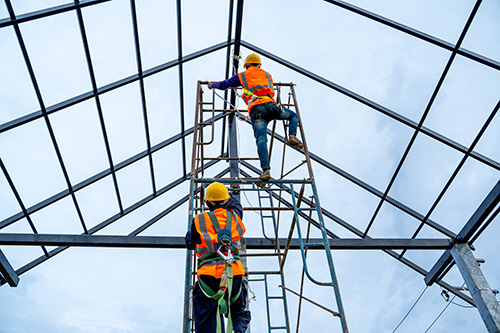
Working at height remains one of the most serious risks in any UK workplace. Falls, falling objects, fragile surfaces and bad weather can all turn a routine task into a life-changing or fatal incident — yet almost every one of these risks is preventable. This guide explains what counts as working at height, the major hazards involved, and the control measures and legal duties set out in the Work at Height Regulations 2005 that keep workers safe.
What is working at height?
Working at height refers to any situation where a person could fall and be hurt if safety measures were not in place. The Work at Height Regulations 2005 set clear rules about what counts as working at height and cover many different jobs and industries.
The Health and Safety Executive (HSE) defines work at height as any place where someone could fall a distance liable to cause personal injury. This includes obvious places such as roofs and ladders, but also less obvious situations such as working near holes in floors. Crucially, the actual height above the ground is not the deciding factor — even falling from ground level counts if there is a pit or opening below.
Key legal points include:
- Any fall that could cause injury counts as working at height.
- The actual height above ground is not the deciding factor.
- Fragile surfaces such as roof lights are included.
- Working near excavations or holes counts too.
Many jobs involve working at height on a regular basis: construction workers use scaffolding, ladders and work on roofs; window cleaners work from ladders or platforms; maintenance workers fix equipment on roofs or high shelves; tree surgeons work at various heights; and warehouse staff use ladders to reach high storage. Even office workers can be working at height when changing a light bulb or accessing high filing areas. The regulations also cover temporary structures, mobile platforms such as cherry pickers, mezzanine floors and the rescue procedures needed if a worker becomes stuck or injured.
Major hazards and risks of working at height
Falls from height account for 30% of all workplace fatalities in the UK (HSE), while falling objects, fragile surfaces and adverse weather create additional serious risks that can result in severe injuries or death.
- 30% of all UK workplace fatalities are caused by falls from height (HSE).
- 2 metres — falls from heights as low as this can still cause serious harm.
- 40 km/h — wind speeds above this make ladder work extremely dangerous.
Falls from height remain the leading cause of workplace fatalities and serious injuries in construction, maintenance and industrial sectors. Workers can fall from relatively low elevations — ladders, scaffolding, roofs or platforms — and still sustain life-threatening injuries. Common fall scenarios include falling through fragile surfaces such as skylights, slipping from ladders or scaffolding, losing balance on elevated platforms, and falling into holes or service shafts. The impact force increases dramatically with height, so even a minor fall can be fatal. Unprotected edges are a particular danger, and poor equipment maintenance — damaged ladders, loose scaffold planks or faulty harnesses — can fail without warning.
Falling objects pose serious risks to workers at height and those below. Tools, materials and equipment gain tremendous force when dropped from elevation. A hammer falling from a scaffold can cause fatal head injuries to workers below. Primary causes include tools dropped by workers, materials dislodged during construction or demolition, equipment knocked loose by wind or vibration, and debris falling through damaged surfaces. Wind can carry lightweight materials a significant distance, and unsecured tools frequently slip from workers' hands — especially when wearing gloves or working in wet conditions.
Fragile surfaces create hidden dangers that may not be immediately apparent. Roof lights, skylights and deteriorated roofing can collapse under a person's weight. Common fragile surfaces include asbestos cement roof sheets, plastic or glass skylights, corrugated metal roofing and deteriorated wooden flooring. Weather exposure — UV damage, frost and thermal expansion — weakens many materials over time without visible signs. Openings in floors, walls or roofs present immediate fall hazards, and surfaces covered by snow, debris or protective sheeting can deceive workers into thinking they are safe.
Adverse weather significantly increases the risks by creating slippery surfaces, reducing visibility and causing equipment instability. Wet surfaces cause slips, ice forms on walkways and ladders, and high winds affect stability — wind speeds above 40 km/h make ladder work extremely dangerous. Temperature extremes affect both worker performance and equipment reliability, and lightning is a severe risk because metal scaffolding, cranes and elevated structures become conductors, requiring immediate work cessation.
Risk assessment and risk management
Risk assessment identifies potential hazards at height, while risk management implements control measures to reduce those dangers. A systematic approach keeps workers safe through proper hazard identification and continuous monitoring.
A working at height risk assessment evaluates the hazards when workers perform tasks at elevated positions. It must identify where falls could occur and determine injury severity. Employers should start by examining the work environment for fragile surfaces, unprotected edges and unstable structures, and account for weather conditions. Key assessment steps include documenting all elevated work areas, measuring fall distances and impact zones, recording existing safety equipment, and noting worker competency and training needs. The assessment must cover specific tasks rather than general activities — different jobs at the same height can present unique risks — and must be updated whenever conditions, equipment or procedures change.
Hazards can be grouped into clear categories:
- Fall hazards — unprotected edges, holes, fragile roofs.
- Equipment hazards — faulty ladders, inadequate scaffolding.
- Environmental hazards — wind, rain, poor lighting.
- Human factors — fatigue, inadequate training, rushing.
The hierarchy of control provides a structured approach to managing the risk: eliminate work at height where possible, then prevent falls, then minimise their consequences.
| Step | Approach | Examples |
|---|---|---|
| 1. Eliminate | Avoid work at height entirely | Work from ground level using extended tools |
| 2. Prevent | Stop falls occurring | Install guardrails, use scaffolding systems |
| 3. Minimise | Reduce the consequences of a fall | Safety nets, fall arrest systems, reduced fall distances |
Regular monitoring ensures control measures remain effective. Equipment inspections, worker feedback and incident analysis identify when improvements are needed, and competent persons should supervise high-risk activities to verify safety procedures are followed correctly.
Fall prevention and control measures
The most effective approach follows a clear hierarchy of protective measures. Workers can be protected through elimination of height work, physical barriers, and systems that catch or arrest falls.
Eliminating the need to work at height provides the highest level of protection. Workers can use extendable tools from ground level instead of climbing, install cables and equipment at ground level, and design lighting masts and similar structures to lower for maintenance. Pre-fabrication allows complex work to happen at ground level before components are raised and installed with mechanical lifting equipment.
Guardrails, edge protection and toe boards form the primary barrier against falls. Guardrails must be at least 950mm high and capable of withstanding significant force. A standard system has a top rail at the required height, intermediate rails to fill gaps, and toe boards — at least 150mm high and flush with the working surface — to stop materials falling to lower levels. Edge protection works best built into permanent structures, but temporary mobile and clip-on systems work where permanent protection does not exist. Regular inspection ensures barriers remain effective, as weather, vibration and impacts can weaken connections over time.
Safety nets and barriers catch workers who fall, reducing injury severity. Nets must be installed as close as possible to the work area, with the maximum fall distance not exceeding 6 metres into the net, and require proper tensioning and support. Soft landing systems such as air bags and foam-filled barriers work well for predictable fall paths. Collective protection of this kind benefits all workers in an area simultaneously, unlike individual harnesses that protect a single worker, and catching systems must be inspected before each use period.
Personal protective equipment and fall protection systems
Proper selection and use of protective equipment saves lives. Workers need correctly fitted harnesses, reliable lanyards and proper helmets to prevent serious injuries from falls and falling objects.
Selecting and maintaining PPE starts with matching equipment to the specific job risks — the height of the work, the surface below, the duration of work, weather conditions and equipment weight limits. Equipment must meet British safety standards, with proper certification checked before use. Workers must inspect all safety equipment before each use: check harnesses for frayed straps or damaged buckles, look for cuts, burns or chemical damage to webbing, and check lanyards for bent hooks or damaged shock absorbers. Any equipment showing wear or damage must be replaced, and all kit stored in a clean, dry place away from sharp objects and chemicals.
Safety harnesses and lanyards distribute fall forces across the body. A full-body harness gives the best protection and must fit snugly — chest strap at mid-chest, leg straps snug around the thighs, back D-ring between the shoulder blades, and no twisted straps. Lanyards connect the harness to anchor points: shock-absorbing lanyards reduce the force on the body during fall arrest, fixed-length lanyards suit fall restraint by stopping workers reaching dangerous areas, and self-retracting lanyards allow more movement while locking quickly when a fall starts.
Fall arrest and fall restraint systems serve different purposes. Fall arrest catches workers after a fall begins and needs strong anchor points — a minimum of 15kN strength — a full-body harness, a shock-absorbing lanyard and connecting hardware, with fall distances calculated carefully so the system stops the fall before impact. Fall restraint instead prevents workers from ever reaching a fall hazard, using shorter lanyards or barriers; it works well on flat roofs with parapet walls or when working near skylights and roof edges. Both systems need regular inspection by trained workers before each use.
Head protection guards against falling objects and head impacts during falls. Industrial safety helmets must meet EN 397 standards and protect against impacts from above and some side impacts, while climbing helmets protect against impacts from multiple directions. Helmets must fit properly, with the suspension adjusted so they sit level, and should be checked regularly for cracks or damage. Any helmet that has taken a significant impact must be replaced, and most helmets need replacement every 3–5 years depending on use and manufacturer guidance.
Equipment and access platforms
Proper equipment selection reduces fall risks and provides stable work surfaces. Each type of access equipment serves a different purpose and needs specific safety measures.
Scaffolds provide stable platforms for extended tasks. Key safety requirements include guard rails at a minimum 950mm height around all platforms, platforms positioned at 2-metre intervals during assembly, built-in access ladders or staircases, toe boards to prevent material falls, and four correctly sized stabilisers. Mobile access towers require competent assembly: the Advance Guardrail (AGR) method installs guard rails from ground level before workers access platforms, while the Through The Trap (3T) method lets workers install guard rails while seated in the trap door opening. Competent persons must inspect scaffolds before first use, at regular intervals based on conditions, and after any event affecting stability.
Mobile elevated work platforms (MEWPs) lift workers and equipment to elevated positions. Operators must assess height requirements, ground stability and surface conditions, overhead obstructions such as power lines, traffic management, and their own competence and training. Soft or uneven ground increases tipping risk and requires stabilisation. Workers should use work restraint to prevent climbing out of baskets, with fall arrest becoming necessary if they must exit the platform. Daily checks verify mechanical systems and safety features.
Cherry pickers and scissor lifts serve different needs — cherry pickers offer precise positioning with articulated booms for confined spaces, while scissor lifts provide stable vertical platforms with larger working areas. Both need trained operators who understand weight limits (workers, tools and materials combined) and operating limitations. Safety protocols include securing loose items before elevation, maintaining three points of contact where possible, avoiding lateral forces on extended platforms, and using PPE as backup protection. Wind speeds above manufacturer limits require work stoppage, and regular inspection of hydraulic, electrical and structural elements catches issues before failures occur.
Training, competence and regulatory compliance
Proper training and regulatory compliance form the foundation of safe working at height. The Work at Height Regulations 2005 establish clear legal duties for employers, while competence standards ensure workers have the skills to operate safely.
Employers must ensure all workers receive adequate training before working at height, covering hazard identification and risk evaluation, the proper use of fall protection equipment, emergency rescue procedures and equipment inspection techniques. Training must be specific to the work environment and equipment, combining theoretical knowledge with practical skill. Competence assessment after training is essential — the BS 8681 standard emphasises competence across all roles, from system designers to installers and inspectors — and regular refresher training keeps skills current. Complex tasks may require specialist qualifications, such as the Level 3 apprenticeship for permanent fall arrest technicians.
The Work at Height Regulations 2005 apply to all employers and those who control work at height activities. Their primary legal requirements are to avoid work at height where possible, conduct thorough risk assessments, use appropriate fall protection systems, and provide adequate supervision. The regulations require a hierarchy of controls that prioritises collective protection over individual measures. Duty holders — including facilities managers and building owners — share responsibility for compliance and must ensure contractors follow proper procedures. Non-compliance can result in prosecution and significant penalties, and the HSE actively enforces these regulations across all industries.
Finally, regular equipment inspection maintains the integrity of safety systems throughout their life. Fall protection systems need both daily pre-use checks and formal periodic inspections by qualified inspectors, supported by comprehensive maintenance to the manufacturers' schedules. Supervision involves monitoring work activities, ensuring proper equipment use, implementing safety procedures and maintaining competence records, while detailed record-keeping of inspections, maintenance and training demonstrates ongoing compliance.
Sources & references
- Health and Safety Executive (HSE) — Work at height and fatal injury statistics, Great Britain
- Work at Height Regulations 2005 (legislation.gov.uk)
- BS 8681 — competence for personal fall protection equipment
- BS EN 397 — industrial safety helmets
Make sure everyone who works at height is properly trained and competent.
Train your team to work safely at height →
Mark writes about working at height, workplace safety, compliance and accredited training for Working at Heights Course, part of Online CPD Academy.