
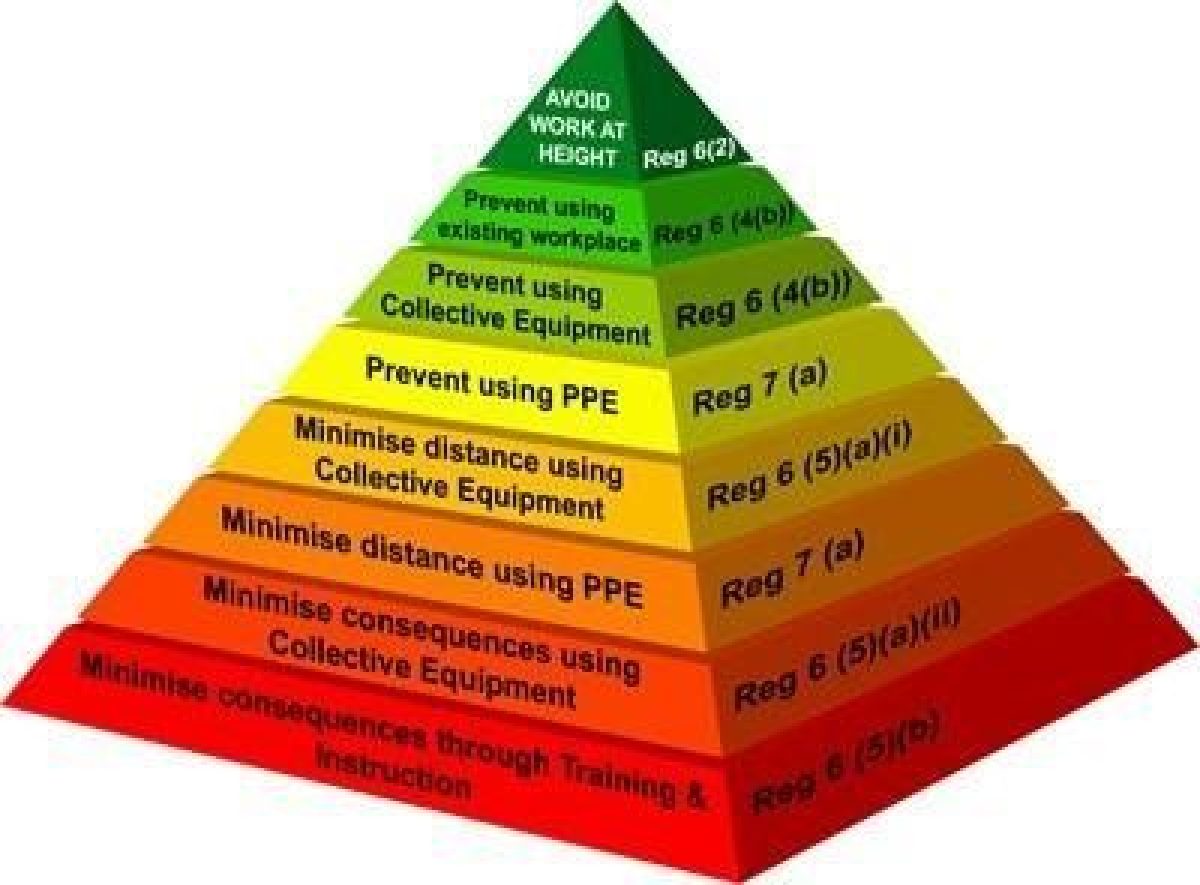
When you plan any task above ground level, the law does not simply ask you to "be careful". The Work at Height Regulations 2005 require you to follow a structured hierarchy of control — a ranked set of measures that puts the most effective protection first and treats personal protective equipment as a last resort. This guide explains each level of the hierarchy, what it means in practice, and the legal duties that sit behind it, so you can choose the right controls for every height task.
Understanding the working at height hierarchy
Working at height means any work where a person could fall a distance liable to cause injury. That includes ladders, scaffolding, roofs and any elevated surface — but height is not only about high places. The regulations also capture work over dangerous substances, near fragile surfaces and close to excavations or pits. The scope covers all work activities, not just construction; offices, retail premises and industrial facilities all create situations that qualify as working at height.
The hierarchy of control gives you a systematic way to manage that risk. It runs through three guiding principles, applied in order:
- Avoid working at height wherever it is reasonably practicable.
- Prevent falls from occurring where the work cannot be avoided.
- Minimise the distance and consequences of a fall if a residual risk remains.
Each level must be fully considered before you move down to the next, so the most reliable measures are always exhausted first. In practice this is most often described as a five-step approach — elimination, substitution, engineering controls, administrative controls and PPE — which expands those three principles into actionable measures.
The Work at Height Regulations 2005 set the legal requirements for employers and workers, and apply to all work at height activities across all industries. Key obligations include risk-assessing every task, following the hierarchy of control, providing suitable equipment and training, and ensuring competent supervision. The Health and Safety Executive (HSE) enforces the regulations and can issue improvement notices or prosecute for breaches, with serious offences carrying significant fines and, in some cases, imprisonment. Employers must ensure work at height is properly planned, supervised and carried out safely, with rescue plans in place and all equipment maintained.
Step 1: Elimination — avoiding work at height
Elimination is the most effective control because it removes the risk completely. The first step is a thorough risk assessment that asks, for every task currently done at height, whether the work truly needs to happen up there at all. Common opportunities include redesigning maintenance work, relocating equipment to ground level for servicing, and designing systems with remote monitoring to reduce the need for inspection.
Building design offers elimination opportunities at the planning stage: services can be positioned at accessible heights, roof-mounted plant relocated to ground level, and access requirements considered before construction begins. Useful questions to ask include: can the task be done differently? Can equipment be moved to ground level? Can remote technology replace physical access? Are there alternative methods available?
Task redesign changes how work is done rather than where. Extending and telescopic tools let workers reach elevated areas from the ground; components can be assembled at ground level before installation; and modular or pre-fabricated systems cut the amount of height work during construction. Real-world examples include lowerable light fittings that bring lamp changes to ground level, water-fed pole systems for cleaning windows from below, ground-level cable installation, telescopic masts for antenna work, and crane-assisted positioning of pre-assembled components.
Step 2: Substitution — safer alternatives to height work
Where height work cannot be eliminated, substitution swaps a high-risk method for a lower-risk one that achieves the same result. A proper risk assessment identifies which methods pose the greatest danger so they can be replaced. Ladders are the most common candidate: mobile elevating work platforms (MEWPs) offer stable, enclosed working spaces, while scaffolding provides secure platforms for longer tasks.
Better access methods reduce risk dramatically. Boom lifts let workers reach height from a protected basket, and scissor lifts give a stable platform for tasks that take time. Ground-based solutions remove height exposure entirely — telescopic poles extend cleaning, inspection and maintenance tools to elevated areas, and remote-operated systems handle work that once required a person at height.
Modern technology adds further options. Thermal-imaging and high-resolution drones inspect roofs, structures and equipment without anyone leaving the ground. Robotic systems clean building exteriors and traverse structures while transmitting live data to technicians below. Whatever the substitution, workers must be properly trained on the new equipment, and the risk assessment should compare the dangers of the original method against the alternative to confirm a genuine safety improvement.
Step 3: Engineering controls — isolating workers from fall hazards
When work must happen at height, engineering controls physically separate workers from the fall hazard. Collective protection — which safeguards everyone in an area without relying on individual action — sits above personal measures in the hierarchy. Passive systems protect automatically once installed; active systems, such as safety nets that must be positioned correctly, require the worker to engage with them. The big advantage of collective protection is that a single guardrail system can protect every worker on a platform, making it highly cost-effective for multi-person operations. Systems must meet the relevant British Standards (BS) and comply with the CDM Regulations 2015.
Edge protection systems combine guardrails, toe boards and intermediate rails. Standard guardrails must be a minimum of 950mm high, with intermediate rails preventing the passage of a 470mm sphere, and fixing points capable of withstanding 0.74kN horizontal loads. Scaffolding provides stable working platforms, with key requirements including a minimum platform width of 600mm, guardrails on all open edges, toe boards at least 150mm high and safe access via internal ladders or stairways. MEWPs deliver controlled access from enclosed baskets with built-in guardrails, often removing the need for separate fall-arrest equipment.
Equipment selection starts with risk assessment, considering working height, ground conditions, weather exposure and task duration. Load requirements must account for workers, tools and materials, and for both static and dynamic forces. Environmental factors matter: wind limits MEWP operation above certain speeds, and wet conditions demand slip-resistant surfaces. Ground bearing capacity determines whether spreader plates or solid bases are needed, while access constraints and task-specific needs — non-conductive equipment for electrical work, fire-resistant materials for hot work — further narrow the choice.
Engineering controls only work if the equipment is sound. Daily pre-use checks catch obvious defects in minutes. Thorough examinations are carried out at set intervals by a competent person — scaffolding requires inspection every seven days and after adverse weather, and MEWPs need examination at least every six months. Annual inspections by qualified engineers provide a comprehensive assessment, and the CDM Regulations mandate record keeping covering inspections, maintenance and competency. A clear defect-reporting route ensures safety-critical faults are fixed promptly.
Step 4: Administrative controls — managing height safety
Administrative controls manage the way work is planned, supervised and carried out. Good planning is the foundation: supervisors identify hazards before work begins, check weather, equipment and worker competence, and build schedules that allow enough time for safe completion — because rushing height work sharply increases the risk of an accident. Planning should include site surveys, equipment inspection schedules, emergency rescue procedures, ground-to-height communication and coordination with other trades. Supervision must be continuous, with qualified supervisors monitoring progress and holding the authority to stop work if conditions become dangerous.
Risk assessments identify the specific hazards of each task and must be written and regularly reviewed, covering fall distances and injury severity, environmental factors, equipment failures and rescue requirements. Method statements turn those findings into step-by-step procedures specific to each job and location; they should list equipment, safety procedures and emergency contacts, and be written in plain language every worker can follow. When conditions change or an incident occurs, assessments must be updated and communicated to everyone affected.
Training and competence underpin everything. All height workers need safety training before they start, covering hazard recognition, equipment use, emergency procedures and when to apply each level of the hierarchy. Competence is best verified through practical demonstration rather than written tests alone, with refresher training to maintain skills. Supervisors need additional training in risk assessment and incident management, and training records must be kept for every worker to demonstrate compliance and flag when refreshers are due.
Step 5: Personal protective equipment as a last resort
PPE sits at the bottom of the hierarchy because it protects only the individual wearing it and relies on correct use. It is the right choice only once higher controls have been applied as far as reasonably practicable. Core fall protection includes full-body harnesses that distribute forces across the torso and legs, connected by lanyards to secure anchor points — energy-absorbing lanyards reduce impact forces, while retractable types allow freedom of movement. Other equipment includes safety helmets meeting the EN 397 standard, high-visibility clothing, safety nets for collective fall protection beneath the work area, slip-resistant safety boots, cut-resistant gloves and eye protection.
Correct use is critical. Harnesses must be adjusted snugly across chest, waist and legs without restricting movement. Anchor points must be inspected before use and able to withstand fall forces of at least 15kN per person. Lanyards connect only to designated harness attachment points — never to belt loops or clothing — and fall-clearance calculations must account for lanyard length, shock-absorber deployment, harness stretch and worker height to prevent ground contact. The 100% tie-off rule means staying continuously connected while moving between anchor points, using twin-tail lanyards or positioning systems.
PPE must be inspected before each use and formally examined at least every six months by a trained inspector checking for cuts, fraying, corrosion and damage. Maintenance follows the manufacturer's recommendations — clean with mild soap and water, and store in a dry, ventilated area away from chemicals and UV light. Equipment must be replaced according to the manufacturer's timescale or immediately after it has arrested a fall, with records kept of inspection dates, maintenance and competence.
Sources & references
- The Work at Height Regulations 2005 — legislation.gov.uk
- Health and Safety Executive (HSE) — Work at height guidance and enforcement
- The Construction (Design and Management) Regulations 2015 — legislation.gov.uk
- British Standards (BS) for access equipment and edge protection; EN 397 for industrial safety helmets
Make sure everyone who works at height understands the hierarchy of control.
Train your team to work safely at height →
Mark writes about working at height, workplace health and safety, compliance and accredited training for Working at Heights Course, part of Online CPD Academy.