
Falls from height remain one of the leading causes of fatal and serious workplace injuries in the UK. The Work at Height Regulations 2005, enforced by the Health and Safety Executive (HSE), set out the legal duties for anyone who plans, organises or carries out work where a person could fall and be hurt. This guide explains who the regulations cover, what employers and workers must do, how to plan and risk assess the work, the hierarchy of control, the equipment involved, and the consequences of getting it wrong.
What are the Working at Height Regulations?
Work at height means any activity where a person could fall a distance liable to cause personal injury. That includes working above ground level — and below ground where a fall could cause harm. The Work at Height Regulations 2005 apply wherever there is a "risk of a fall liable to cause personal injury", so there is no fixed minimum height in metres or feet that triggers the rules.
Common examples include working on ladders or scaffolding, rooftop maintenance, window cleaning above ground-floor level, working near fragile surfaces, and tasks on platforms or raised areas. The regulations cover temporary work as well as permanent workplaces, and even low-level work can require precautions where an injury risk exists.
The regulations apply to all employers, the self-employed and anyone who controls work at height — including facilities managers and building owners who contract others. They span construction sites, industrial facilities and warehouses, offices and retail premises, and temporary work locations. They sit alongside other health and safety law: construction work has additional duties under the Construction (Design and Management) Regulations 2015. The HSE enforces the regulations and publishes official guidance to help organisations comply.
| Group | Key responsibilities |
|---|---|
| Employers | Plan, organise and supervise work at height |
| Those in control of work | Ensure proper equipment and procedures are used |
| Workers | Take reasonable care and follow instructions |
Legal duties and responsibilities
Employers and duty holders must ensure all work at height is properly planned, supervised and carried out by competent people. That means conducting thorough risk assessments before work begins, selecting appropriate equipment for each task, checking that weather conditions are suitable, and having emergency rescue procedures in place. The Management of Health and Safety at Work Regulations 1999 work alongside the height rules, requiring employers to assess risks and implement controls. Those in control of work cannot delegate these legal responsibilities to contractors or subcontractors.
Employees also have legal duties. They must take reasonable care of themselves and others affected by their actions, cooperate with their employer on safety, use equipment properly, follow training and instructions, report dangerous situations or faulty equipment, and never misuse or interfere with safety systems. Workers should refuse tasks where they lack the proper training or equipment, and stop work if conditions become unsafe.
All work at height must be carried out by competent people with the right skills and knowledge. Competence combines technical ability with an understanding of safety requirements — relevant training and qualifications, practical experience, knowledge of hazards and controls, and the judgement to recognise when conditions have become unsafe. Employers must provide adequate supervision, especially for inexperienced workers, with the level of supervision matched to the complexity and risk of the task.
Planning, risk assessment and organisation
Every work at height activity needs a specific risk assessment that identifies the hazards and the control measures. Employers must assess the risks, decide on the precautions required and record the significant findings. The process should not be overcomplicated — many firms have well-known risks with established controls — but it must be carried out by someone competent and reviewed when conditions change. Typical hazards to consider include:
- Falls from ladders, scaffolds and working platforms.
- Falls through fragile roofs or rooflights.
- Falling objects that could injure workers below.
- Unstable surfaces or inadequate edge protection.
Effective planning takes the risk assessment findings and turns them into safe working arrangements: selecting the right access equipment and safety systems, ensuring workers are properly trained, preparing clear method statements (illustrated with simple sketches where helpful), and assigning competent supervisors. The equipment needed for safe working must be identified and available before work starts, and workers must know what to do if the planned method needs to change mid-task.
Weather and the working environment matter too. High winds, rain or ice, poor visibility and extreme temperatures all increase the risk of a fall, and work should be postponed when conditions make it unsafe. Employers must provide adequate lighting for low-light work and keep the area tidy so that debris or standing water does not add slip hazards.
The hierarchy of control and prevention
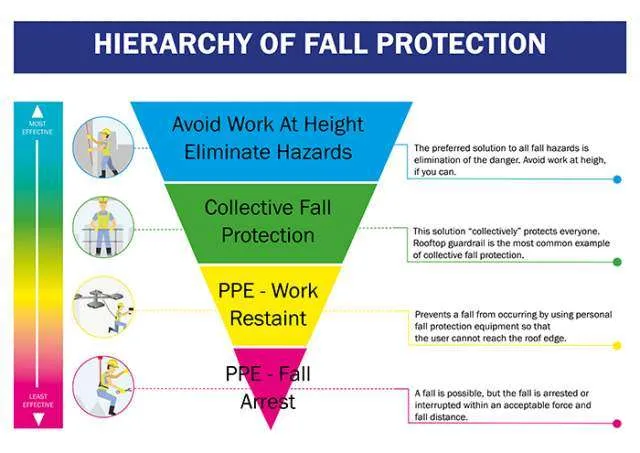
The regulations require a tiered approach to managing the risk — the hierarchy of control. The first step is to avoid work at height altogether wherever it is reasonably practicable, because removing the risk gives the highest level of protection. That can mean assembling components at ground level and lifting them into position (for example, fitting guardrails to steelwork on the ground and craning it into place), using pre-fabricated parts, installing safety nets with extending poles, or using remote and automated systems.
Where work at height cannot be avoided, the next step is to prevent falls using collective protection — measures that protect everyone in the area at once, without relying on each individual. Examples include existing safe places of work such as flat roofs with permanent edge protection, independent and tower scaffolds with integrated guardrails, and mobile elevating work platforms (MEWPs) and mast climbing work platforms (MCWPs) with built-in guardrails, toe boards and barriers.
If collective prevention is not reasonably practicable, the focus shifts to minimising the distance and consequences of a fall. Fall restraint systems use short lanyards to stop a worker reaching a fall position; personal fall arrest systems stop a fall in progress, with anchor points positioned above the worker and the fall distance limited to prevent serious harm; and collective mitigation such as safety nets and soft-landing systems reduce the consequences when positioned close to the work. Training and procedural controls underpin every level of the hierarchy.
Safe use of work equipment and platforms
Employers must choose the most appropriate equipment for the job, based on the nature and complexity of the work, how long it will take, the environment, the number of workers and the materials being handled. As a general order of preference, permanent fixed platforms come first, followed by temporary working platforms, MEWPs, scaffolds, and ladders as a last resort. Wherever possible, guardrails, barriers and toe boards should be used in preference to relying on personal protective equipment alone.
Ladders remain acceptable for short-duration, low-risk work where other access methods are not practical, provided they are suitable for the task and properly maintained. A leaning ladder should be set at roughly a 4:1 angle — the base one metre out for every four metres of height. Workers should carry out a pre-use check for damaged rungs, bent or cracked stiles, secure locking mechanisms and clean, non-slip feet, and should maintain three points of contact when climbing, carrying tools in a holster or raising them separately by rope.
Scaffolds provide stable platforms for longer projects and must be erected by competent people and inspected regularly. The key dimensions below are the standard requirements referenced in the guidance.
| Scaffold / platform requirement | Standard |
|---|---|
| Main guardrail height | At least 950 mm |
| Intermediate guardrail | Gap no greater than 470 mm |
| Toe board height | At least 150 mm |
| Minimum platform width | 600 mm |
| Maximum gap between boards | 25 mm |
| Inspection interval | Every 7 days, and after adverse weather |
Working platforms need full boarding with minimal gaps, secure fixing to prevent movement, and access points with proper gates or removable guardrails. Loading bays require additional strengthening and clear weight-limit markings, and only authorised personnel should modify or dismantle a scaffold.
PPE and fall protection systems
Personal protective equipment is the last line of defence, used when higher controls cannot fully manage the risk. A full-body fall arrest harness distributes the forces of a fall across the chest, shoulders and legs, and must be inspected before each use for cuts, fraying or damage. Lifelines connect the harness to a secure anchor point — static lifelines stay fixed, while retractable types extend and retract automatically. Anchor points must support at least 15 kN of force per person attached, and an engineer should verify their strength before installation. Shock absorbers reduce the forces transmitted to the worker, and free fall should not exceed 1.5 metres in most situations.
| PPE type | Primary function | When required |
|---|---|---|
| Harnesses | Fall arrest | Individual work above 2 m |
| Safety nets | Collective protection | Large work areas |
| Guardrails | Fall prevention | Permanent installations |
| Helmets | Head protection | All height work |
Equipment alone is not enough: a rescue plan must be in place before work begins. Suspension trauma can develop when a worker hangs motionless in a harness, so rescue teams should be able to reach a suspended worker quickly — within around 15 minutes — using ropes, pulleys and descent devices kept readily accessible. Rescue team members must be trained to use the equipment and should practise scenarios regularly. Serious falls should be reported to the emergency services immediately, and first-aid-trained personnel should assess an injured worker before they are moved.
Special hazards: fragile surfaces and falling objects
Fragile surfaces are a major cause of serious roof-work accidents, often during short maintenance jobs. Employers must avoid work on fragile surfaces where possible; where it is unavoidable, they must combine several measures — staging, guardrails, fall restraint and safety nets positioned beneath and close to the roof. All roofs should be treated as fragile until a competent person confirms otherwise. Surfaces to treat with particular caution include:
- Non-reinforced fibre-cement sheets.
- Rooflights set in the roof plane.
- Corroded metal sheets.
- Glass surfaces, including wired glass.
- Rotted chipboard and similar materials.
- Liner panels on built-up roofs.
Warning notices must mark every approach to a fragile surface, workers need specific training before starting, and contractors and clients should agree safety arrangements before work begins on business premises.
Falling objects pose a serious risk to anyone working or passing below. Employers must prevent objects falling and protect people underneath using toe boards on scaffolds and platforms, debris netting, tool lanyards for handheld equipment, covered walkways and exclusion zones beneath work areas. Materials and tools should be secured or contained during lifting, never thrown from height, and loose materials must not be stored near platform edges. Containment measures should be inspected regularly to confirm they remain effective.
Enforcement, penalties and consequences
The HSE is the primary enforcement body for working at height in the UK. Inspectors can enter premises without notice, interview employees and examine workplaces, and they investigate every workplace fatality and serious injury involving a fall from height. Where they find problems, they can issue an improvement notice requiring fixes within a set timeframe, or a prohibition notice that immediately stops dangerous work until it is made safe. Notices and inspector findings become evidence in any subsequent legal proceedings.
Penalties for breaches have risen significantly. Courts can impose unlimited fines on businesses, and individuals can face fines and — for gross breaches of duty — imprisonment, with personal liability extending to company directors. Companies have received six-figure fines for failures such as not providing proper edge protection on rooftops, even where no one was hurt. On top of criminal penalties, injured workers can pursue civil compensation, and a serious breach brings reputational damage and higher insurance premiums.
Falls from height remain one of the leading causes of workplace fatalities and serious injuries in the UK, frequently resulting in permanent disability such as brain or spinal injuries and multiple fractures. The human cost reaches beyond the injured worker to colleagues and families. Investigations regularly conclude that proper, foreseeable safety measures would have prevented the incident — which is exactly why competent training and a properly applied hierarchy of control matter so much.
Sources & references
- Health and Safety Executive (HSE) — The Work at Height Regulations 2005: A brief guide (INDG401)
- legislation.gov.uk — The Work at Height Regulations 2005 (SI 2005/735)
- Health and Safety Executive (HSE) — Construction (Design and Management) Regulations 2015 and roof-work guidance
- legislation.gov.uk — Management of Health and Safety at Work Regulations 1999
Give your team the knowledge to plan and carry out work at height safely and legally.
Train your team to work safely at height →
Mark writes about working at height, workplace safety, compliance and accredited training for Working at Heights Course, part of Online CPD Academy.